Quien no conoce el Sáhara cree que en el desierto sólo hay arena. Pero en el desierto hay niños, y niñas, que juegan, y que dibujan y hacen películas, y a quienes les gustaría no tener que pensar en la guerra. En el desierto hay una colonia europea, un país ocupado llamado Sáhara Occidental, y hay miles de refugiados que viven en el exilio una vida dura. “Pequeño Sáhara” es un documental animado que narra su historia, la de una gente solidaria y resistente que crece en donde a todo le cuesta crecer.
Those who do not know the Sahara think that in the desert there is only sand. But here there are children, who play and draw and make movies, and who would like not to have to think about war. In the desert there is a European colony, an occupied country, called Western Sahara, and there are thousands of Sahrawi refugees living a hard life in exile. LITTLE SAHARA is an animated documentary that tells their story, that of a solidary and resilient people who try thrive and grow up in the Hamada, where everything struggles to grow.
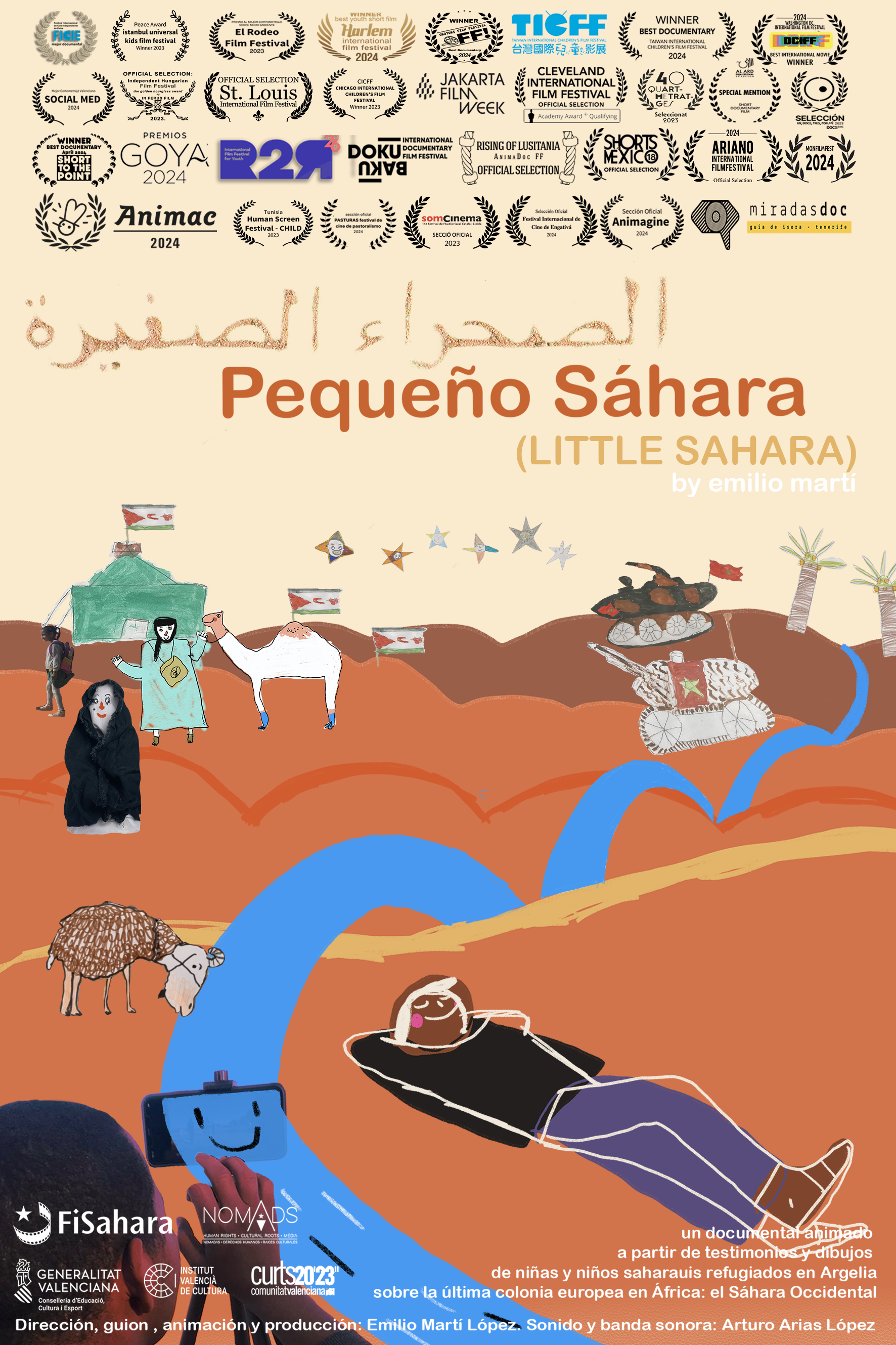
🇪🇸»PEQUEÑO SÁHARA» es un documental animado realizado a partir de los talleres de animación llevados a cabo por Emilio Marti en los Campos para población saharaui refugiada en el desierto argelino. Usando el testimonio de los más pequeños (la versión original de la película es en árabe hasanía) se explica la historia del Sáhara Occidental, por qué es la última colonia europea (española) en África, cómo es que Marruecos la ocupó, y qué significa tener que vivir refugiado en el desierto para no sufrir la guerra y las represalias marroquíes. Todo esto, ilustrado con dibujos y animaciones realizadas por y a partir de los estudiantes de la escuela Pioneros 20 de mayo, en el desierto. Los talleres fueron posibles gracias a Fisahara y Nomads, y la distribución del cortometraje durante 2023 la hará el Institut Valencià de Cultura Generalitat Valenciana, con su catálogo CURTS.
🇬🇧»LITTLE SAHARA» is an animated documentary made from the animation workshops carried out by Emilio Marti in the Camps for the Saharawi refugee population in the Algerian desert. Using the testimony of the students of Pioneers School in Tindouf (the original version of the film is in Arabic Hasania) «LITTLE SAHARA» tells the history of Western Sahara, the reasons of it being the last European (Spanish) colony in Africa, how Morocco occupied it, and what it means having to live as a refugee in the desert so as not to suffer the war and the Moroccan reprisals. All this, illustrated with animations made by the young students or from their drawings and paintings. The workshops were possible thanks to Fisahara and Nomads, and the distribution of the short film during 2023 will be done by the Institut Valencià de Cultura Generalitat Valenciana, in its «CURTS – BEST OF VALENCIAN FILM» catalogue
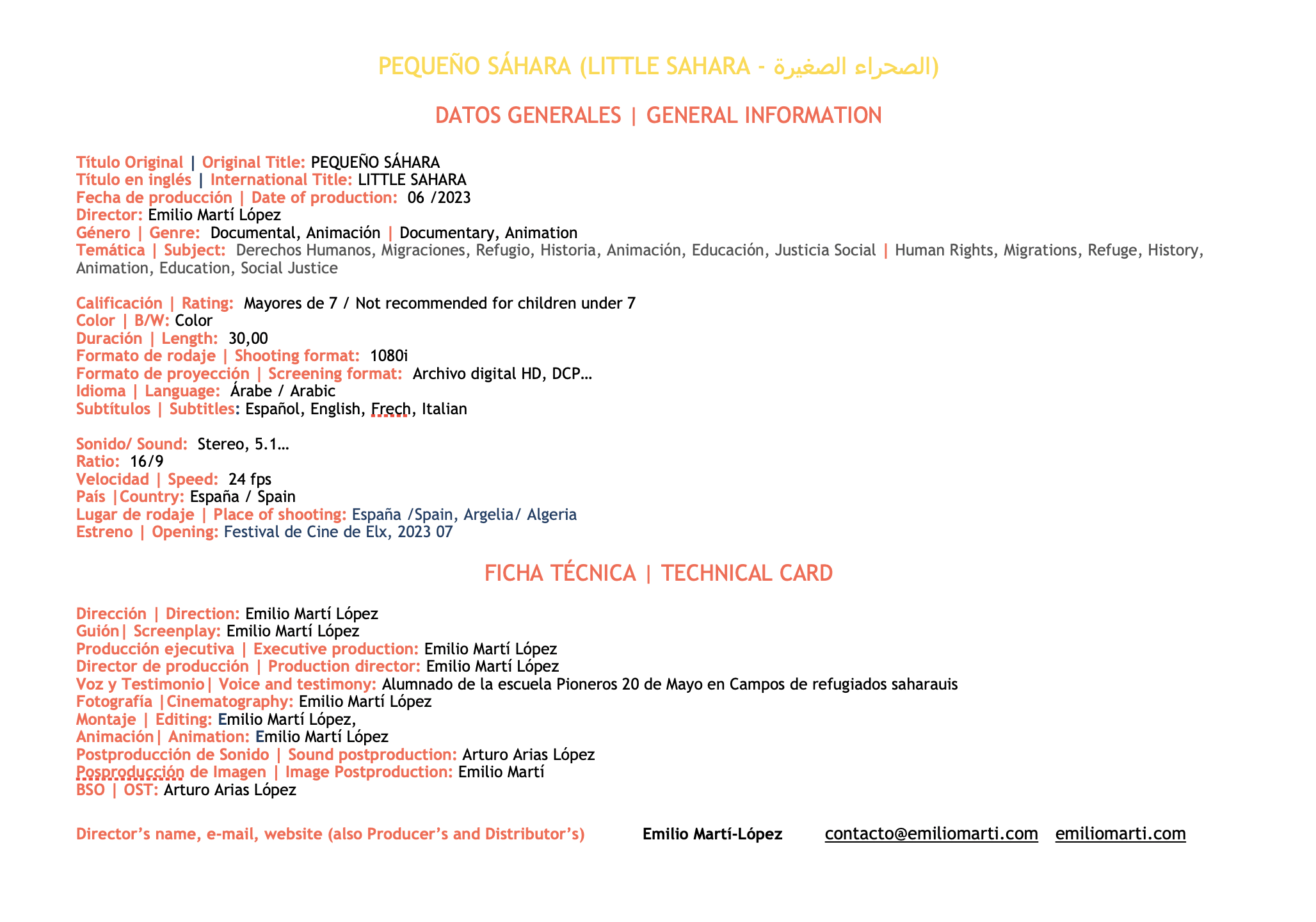
Festivales y Premios Recibidos | Festival screenings and awards (March. 2024)
AWARDS
Best Documentary Short Film, 46 International Independent Film Festival Elche (Spain, 2023) *** Preselección Goyas 2024 *** Human Rights and Peace Awards, Festival Ciutadà Compromés València (Spain, 2023) *** Best short documentary, Independent Hungarian Film Festival (Hungary, 2023) *** Best co-created short documentary, DocsMéxico – Un Docs Tres (México, 2023) *** Peace Award, Universal Kids Film Festival, Istanbul (Istanbul, Turkey, 11 2023) *** Best international movie, DC Independent Film Festival (Washington DC, USA, 02 2024) *** Jury’s Special Mention to Best Documentary, Al Ard Film Festival, (Sardinia, Italy, 02 2024) *** Best Short Film ,Valencia Region, Mediterranean Human Rights Film Festival Social Med 24 (Valencia, Spain – 04 2024) *** Best Documentary, TIFCC (Taipei, Taiwan – 04 2024) *** Best Short Documentary, Short to the Point (Bucarest, Romania – 05 2024) *** Best Youth Short Film Award, Harlem International Film Festival 2024 (NY, EEUU – 05 2024) *** Best Documentary, Okotoks Film Festival (Alberta, Canada – 06 2024);
Official section (selection): 46 Festival Internacional de Cine Independiente de Elche (España, 07-2023). Festival de Cine El Rodeo, Rojales, Alicante (España, 08-2023); 18 SHORTS MEXICO (Mexico, 09-2023); International Documentary film Festival DokuBaku IDFF (Azerbayán, 09-2023); 14 SOM CINEMA Festival de l’Audiovisual Català (Lleida, España, 10-2023); Jakarta Film Week (Indonesia, 10-2023); Universal Kids Film Festival (Estanbul, Turquía, 10-2023); Docs Mexico (Mexico DF, 10-2023); Quartmetratges (València, 10- 2023); Sección Panorama en V RISING OF LUSITANIA AnimaDoc Film Festival (Polonia, 11 -2023); St. Louis International Film Festival 2023 (EEUU, 11-2023, Academy Award Qualifying); Chicago International Children’s Film Festival (EEUU, 11-2023, Academy Award Qualifying) ; Ningbo Short Film Festival (China, 09-2023); Independent Hungarian Film Festival (10-2023); Taiwan International Children’s Film Festival (03-2024); DC Independent Film Festival (DCIFF, Washington DC, EEUU, 02 2024); Al Ard Film Festival (Sardinia, Italy, 02-2024); Reel to Real, R2R INTERNATIONAL FILM FESTIVAL FOR YOUTH 2024 (Vancouver, Canadá, 04- 2024); Animac 2024: Animac Muestra Internacional de Cinema de Catalunya (Lleida, Spain, 02- 2024); 48 CIFF Cleveland International Film Festival (Ohio, EEUU, 04-2024, Academy Award Qualifying); SHORT to the Point (Târgu Mureș, Rumanía, 04-2024); Social Impact Film Festival (Boston, EEUU, 04-2024) ; Cinemafost 2024 (Sant Fost de Campsentelles, Barcelona, 04 2024); SIFFCY (Smile International film festival for children & youth) (New Dehli, India, 04 2024);
🇪🇸Director’s Statement. Como cineasta y arteterapeuta, creo en el poder del arte y el cine para cambiar las realidades sociales y mejorar la vida de las personas. Creo que es de suma importancia que contemos esas historias que se cuentan menos y que aprendamos a mirarlas y escucharlas, especialmente cuando afectan algo que nos afecta a todas: los derechos humanos, el derecho a la felicidad, el derecho a una vida segura y significativa. A través del cine —especialmente del documental animado— trato de usar el arte para dar vida a historias que hablan de la necesidad de estos derechos que a veces damos por sentado, y trato de hacerlo de una manera conmovedora, que dé espacio a la esperanza y eso es de alguna manera un llamado a la acción. Mis películas intentan acceder a esos lugares de difícil acceso a través de material documental en bruto (como en MAKUN, en el que animamos los dibujos encontrados en un centro de detención donde no se permite la entrada a los periodistas) o porque el tema puede sentirse árido y difícil de entender. (como en PEQUEÑO SAHARA, donde un conflicto de 50 años mantiene a miles de personas viviendo en medio del desierto).
🇬🇧 Director’s Statement. As a filmmaker and an art therapist I believe strongly in the power of art and filmmaking to change social realities and to improve people lives. I think that it is of the upmost importance that we tell those stories that are rarely told, and that we learn to watch and listen to them, especially when they affect something that affects us all as humans: human rights, the right to happiness, the right to a safe and meaningful life. Through film —and especially animated documentaries— I try to use art to give life to stories that talk about the need for these rights that we sometimes give for granted, and I try to do so in a moving way, that gives space to hope and that is somehow a call to action. My movies try to access those places difficult to access through raw documentary materials (as in MAKUN, in which we animated the drawings found in a detention center where reporters are not allowed in) or because the theme can be felt as arid and difficult to understand (as in LITTLE SAHARA, where a 50 years old conflict keeps thousands of people living in the middle of the desert).
 Emilio Marti